Monday, April 25, 2016

2016: the year of the next global financial crisis?

So far this year gloom has dominated the headlines – falling stock markets, low trade goods costs, risks of debt crises in developing countries and risks of deflation. Some banks have even suggested investors sell everythingaside from “safe” (usually government) bonds; whereas the Chancellor martyr John Osborne has talked a few“cocktail of [global] threats” to the united kingdom economy.

Both the UN agency and also the International Bank for Reconstruction and Development have revised theirworld growth expectations downward for this year. Low growth can significantly have an effect on developing countries which require gross domestic product growth to extend living standards.

The economic press typically presents the drivers of those risks as being freelance from one another. howeverit's value asking whether or not it's doable to attach the dots between them.

The aftermaths of the Chinese slowdown…

The main reason for slow world growth in 2016 are going to be China. After 2008, with less demand for its exports in crisis-ridden developed countries (most notably the US), China tried to rebalance its economy. It tried to catch up on reduced export revenue by inciting infrastructure investments and increasing domestic consumption. For a number of years, this strategy appeared to work, however this can be not the case any longer – it resulted within the creation of domestic bubbles (notably within the real estate), that ar currentlyexploding. As a consequence, China is commercialism less material and commodities from alternative developing countries.this can be why the worth of those commodities is shrinking: there's an excessive amount of offer and not enough demand to fulfill it.

Parts of the developing world that specialised in mercantilism commodities to China ar currently experiencing a discount of export revenue (which conjointly affects their public finances). As a result several resident countries (including the largest one, Brazil) ar presently either in outright recession or stagnating. constant applies for a fewAfrican and Asian countries.

…in its wider context

At constant time, OPEC’s call to flood the globe with low cost oil (an conceive to kill the United States of America sedimentary rock industry) has conjointly translated into reduced oil exports revenue for a fewdeveloping countries – like Asian country, Russia, Republic of Venezuela and even Brazil or South American nation. as an example, Russia is on the sting of recession whereas Venezuela’s economy shrunken by 100 percent in 2015.

Finally, several European economies ar still fragile, because the Eurozone remains a deficient currency union – incapable of addressing its poor economic performance post-2008. The Eurozone as a full grew by solely zero.3%within the half-moon of 2015, with Republic of Finland, European nation and Balkan state posting a negativerate and Portuguese Republic and France nearly stagnating. 

Connecting the dots?

Deep down, several of the risks to {the world|the worldwide|the world} economy is copied back to skimpy global demand for supporting current levels of production.

In the developed world, real wages ar stagnant or decreasing, whereas most governments ar jutting to self-denialpolicies that contract economic activity and employment. The Chinese economic retardation conjointly means thatreduced demand for commodities and energy from the remainder of the globe.

In this context, the most sources of world demand ar presently the United States of America and kingdom non-public sectors, wherever demand is unbroken afloat not through will increase in real wages, however throughnon-public sector (including household) debt and bubbles (e.g. the united kingdom housing market). however –other than the risks of such imbalances – although these countries keep intense quite they manufacture (by running sizeable accounting deficits), this can be not enough for world production to stay increasing at a goodpace.

How will this link to recent turmoil?

For one, it affects monetary investment perceptions – and so stock markets. The deceleration down of worldproduction and trade can place the profit of the many economic activities into doubt. this can be one in all the explanations why monetary sector analysts ar nervous: they concern that several of the assets they hold (e.g. stocks and bonds) ar overvalued – and are becoming eliminate them.

Second, the retardation of economic activity implies that a part of the debt accumulated within the world economycould also be unsustainable. the globe emerged from the 2008 crisis with huge non-public and public sector debts. The economics policies pursued when 2008 didn’t very facilitate scale back this debt – they ratherjunction rectifier to a migration of world debt from one sector to a different, and from some geographic areas to others.

The problem is that if the financial gain from that these debts ar alleged to be repaid is reduced or not growingquick enough, then several of them could become unsustainable and unrepayable – bar terribly unconventional policies. this could spark new crises across the globe. and also the connection of world finance implies that no country is secure from such risks, least of all the united kingdom.

Friday, April 8, 2016

Anglia Ruskin University


Image result for Anglia Ruskin University
History: 
Parts of it backtrack to the nineteenth century. The most antiquated part opened in 1858 as a school of craftsmanship established by the Victorian workmanship faultfinder John Ruskin. In 1989, two entrenched universities, the Essex Institute of Higher Education and Cambridgeshire College of Arts and Technology, met up to frame the main territorial poly. Turned into a college in 1992 and changed its name from Anglia Polytechnic University (APU) to Anglia Ruskin University in 2005.

Address:
The three fundamental locales are at Cambridge, Chelmsford and Peterborough.

Mood: 
Cambridge-based understudies will have entry to a flawless and profoundly understudy driven notable city. Since understudies make up a substantial piece of its populace, it's generally lively, with parcels to see and do. Chelmsford hums with nightlife and attractions for culture vultures. There are extraordinary strip malls, a secured showcase, an ice arena and loads of games clubs. In addition, the V celebration goes to the city's Hylands Park each August.

Queen's University Belfast


History:
Previously Queen's College Belfast, established in 1845. One of three schools to be built up in Ireland by Queen Victoria. Turned into an autonomous college in 1908 and commended its century in 2008 with a scope of prominent occasions, including an illustrious visit by Her Majesty the Queen and the Duke of Edinburgh.

Address:
A 15-minute stroll from the downtown area on University Road in Belfast, Northern Ireland.

Vibe: A verdant grounds flanking the city's Golden Mile in the Queen's Quarter. Right by a clamoring focus of bars, clubs and eateries and near the buzzy Botanic Avenue. Belfast has been supported by late venture and the idealism of the progressing peace handle.

Who's the supervisor? Patrick Johnston, an all inclusive famous master in disease investigate, assumed control from Professor Sir Peter Gregson in March 2014.

Abertay University


History:
It's been a focal point of learning subsequent to being established in 1888. Be that as it may, depicted by the Scottish Office as 'a mechanical college' in 1902, it wasn't permitted to call itself a college until April 1994. It's likewise had three past incarnations: Dundee Institute of Technology; Dundee College of Technology; and Dundee Technical Institute. As of late it changed its name to Abertay University.

Address:
Center of Dundee.

Vibe:
One of the UK's littlest colleges, with numerous nearby understudies, be that as it may, non-UK understudies make up right around 20 for every penny of the understudy body with more than 60 nationalities spoke to. Blend of Edwardian, 1960s and grant winning 1990s/2000s structures including a cutting edge library, understudy focus and revamped instructing and inquire about structures. Extraordinary shorelines with slope strolling and ski inclines close by. Dundee is the focal point of Scotland's biotechnology and computerized commercial enterprises.

Arts University Bournemouth


History:
Established in 1883 in Bournemouth and 1913 in Poole, and turned into an advanced education organization in 2001. Accomplished taught degree honoring controls in 2008, and changed its name to the Arts University College at Bournemouth in July 2009. In 2012, with a change to enactment, the Privy Council granted AUCB college status and the establishment embraced the title the Arts University Bournemouth (AUB). One of just a couple HEIs that emphasis only on innovative work in contemporary craftsmanship, configuration, media and execution.

Address:
The grounds is at Wallisdown, somewhere between Bournemouth and Poole.

Feel:
AUB is arranged in the middle of Bournemouth and Poole in Dorset, on the south bank of England. Dorset is a region of remarkable normal magnificence, giving a one of a kind area to inventive work. It gloats miles of sandy shorelines, the moving Purbeck Hills, Poole Harbor and open door for an abundance of water games. Bournemouth has a huge cosmopolitan understudy populace, and a standout amongst the most dynamic club scenes outside London.

Who's the supervisor? Teacher Stuart Bartholomew is main and CEO. He has broad experience and is a kindred of the RSA.

University of the Arts London

History: Formerly known as the London Institute, formed in 1986, University of the Arts London was formally inaugurated in May 2004.
Address: Six colleges with 14 various sites around London make up the university, from the London College of Fashion on Oxford Street to the London College of Communication in Elephant and Castle. In autumn 2004, Chelsea College of Art and Design moved to Millbank, next door to Tate Britain. In August 2006, Wimbledon School of Art joined the University as the sixth college. Central Saint Martins College of Art and Design moved to a brand new state-of-the-art site in King’s Cross in 2011.
Ambience: The Chelsea site at Millbank is full of cool, art-student types; London College of Fashion is also very hip, though more worldly; ditto Central Saint Martins. London College of Communication has a flash new media school and enterprise centre. Based on an airy, spacious campus, Wimbledon is a close-knit creative community, while Camberwell is the epitome of an urban, artistic hub.

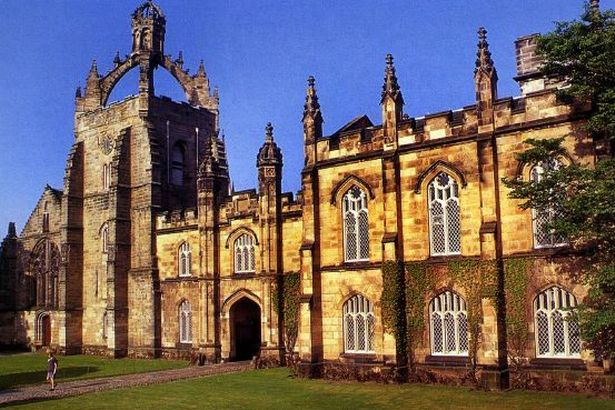
Aberdeen University

History: Founded in 1495, by 1497 it boasted the first chair of medicine in the English-speaking world. Four Nobel Prizes have been awarded for work carried out at the university. Picturesque and historic Old Aberdeen is now the main University site.
Address: Two sites in north-east Scotland's Aberdeen. Hills, countryside and miles of golden sandy beaches surround it. The medical school is based a mile and a half from the main campus.
Ambience: A 15th-century campus in a historic part of Scotland's bustling third largest city. Aberdeen is known in tourist circles as The Granite City, The Flower of Scotland, and The Silver City by the Golden Sands. Crammed with sparkling granite buildings, cosmopolitan Aberdeen has a thriving economy and buzzing town centre, as well as a beach ruled by stiff North Sea breezes and gutsy seagulls.
Who's the boss? Professor Sir Ian Diamond is principal and vice-chancellor, a former deputy vice-chancellor at the University of Southampton and PhD student at the University of St Andrews.